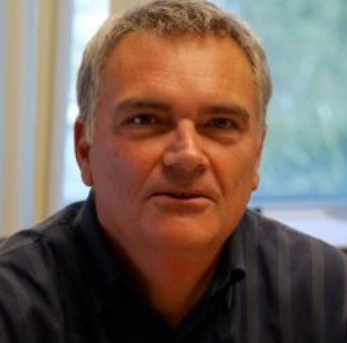
Edward Large
Music is among the most powerful examples of how brain, body, and environment can enter into dynamic resonance. Recent advances in neuroscience reveal that neural oscillations synchronize with musical rhythms and tonal structures across multiple timescales—from slow cortical delta and theta rhythms that entrain to musical beat and pulse, to fast auditory and brainstem oscillations that encode pitch and harmony. In this talk, I present Neural Resonance Theory (NRT), a unifying framework that explains how such synchronization gives rise to perception, action, and emotion in music. Drawing on canonical models of nonlinear dynamics, NRT describes how physical principles—resonance, stability, attunement, and strong anticipation—govern the emergence of musical experience as an embodied neurodynamic process. Stable patterns of neural resonance correspond to perceptual and cultural universals in rhythm, tonality, and affect, while attunement through Hebbian plasticity accounts for learning, enculturation, and expertise. This dynamical approach reinterprets music cognition not as a process of symbolic prediction, but as a manifestation of lawful brain–body–environment coupling—illustrating how consciousness itself may arise from the resonant dynamics of living systems.